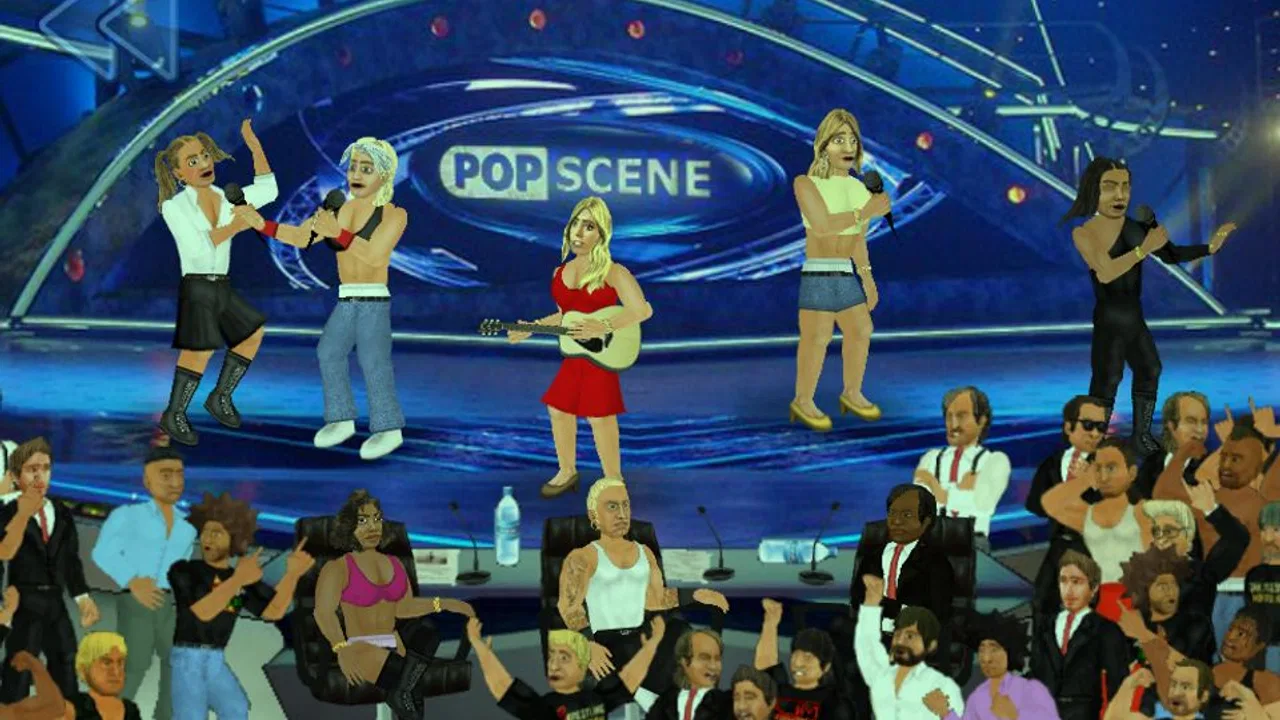
Popscene
- 3.8
- Rating
- 5.00M
- Installs
- Free
- Price

 Analysis by App-foxy
Popscene is the kind of music game that makes a strong first impression because it does more than ask me to tap along to a song. It puts me in the middle of an imagined music career, where the collection of tracks becomes something I actively manage and perform with. That broader idea gives it more personality than a straightforward rhythm game, but it also means the experience depends heavily on whether I enjoy making decisions around music rather than simply playing through songs.
After spending time with it, I see the appeal clearly. This is a free game from MDickie, released on January 30, 2014, and it remains an unusual option for anyone who wants a music-themed experience with a career angle. It is rated for Everyone, works on Android 5.0 and later, and has passed five million installs. Its average rating sits at 3.8 from roughly fifty-six thousand ratings, which feels consistent with my impression: the concept is distinctive and entertaining, while the presentation and repetition will not suit every player.
Why the first week feels more interesting than a normal music game
My first few sessions were driven by curiosity. Instead of treating songs as isolated levels, Popscene encourages me to think about how a music collection can support a rising career. That makes even small choices feel connected to a larger goal. I am not only asking whether a track is enjoyable; I am also wondering how it fits into the identity I am building and whether I want to keep returning to it.
You May Also Like

 Blood Strike: 2.5 Anniversary
Blood Strike’s Loadouts Turn Every Drop Into a Tactical Gamble
A close look at Blood Strike’s custom loadouts: how fast access to signature weapons reshapes its battle royale rhythm, rewards preparation, and narrows the gap between fights.

 Pandora - Music & Podcasts
Pandora’s Music Is Easy to Start, but Harder to Recover
Pandora’s strength is its low-effort path from a seed to a station. Its weak spot is how much confidence it asks you to place in connection, setup, and quiet recovery.

 8 Ball Pool
 Is Built on Rivalries, Rematches, and Routine
A close look at the rivalries, rematches, shared routines, and unanswered safety questions that turn a quick pool match into a persistent mobile community.

 Samsung Music
’s Quiet Strength Is Playing What You Already Own
Its reach comes less from spectacle than from dependable access to a personal library. That simplicity is both the app’s strongest retention engine and its ceiling.

 AccuWeather: Weather Radar
AccuWeather Review: A Quick, Clear Forecast for Everyday Decisions
For everyday plans, the best forecast is the one you can understand quickly. AccuWeather makes rain timing, radar, and local conditions easy to act on, with a few trade-offs.

 Hill Climb Racing
Why Hill Climb Racing Still Turns Crashes Into One More Run
A tiny car, a bumpy hill and one more upgrade: Hill Climb Racing keeps resurfacing because its simple chaos makes every near-miss feel personal.
More From Our News Desk



That career framing is the game’s most important strength. Many music games are built around immediate accuracy, quick reactions, or unlocking another performance. Popscene gives me a reason to care about the journey between those moments. The result feels closer to a lightweight music-industry sandbox than a pure rhythm challenge, even though music remains the center of everything.
The early appeal also comes from experimentation. I can try different approaches instead of following one obvious route from beginning to end. In the first week, that freedom is refreshing because I am still learning how the game’s choices affect my progress. I found myself testing ideas simply to see what would happen, and that kind of curiosity is difficult to create in a game that only rewards perfect repetition.
The best way to approach the opening sessions is as a learning period, not a race to optimize. I recommend trying several styles before settling into a routine. If I focus too quickly on doing everything “correctly,” I lose some of the charm that comes from discovering how the career layer works. Popscene is more enjoyable when I treat the first few days like an experiment with a soundtrack.
A useful choice for players who want music with context
This is particularly appealing if I like management ideas but do not want a complicated business simulator. Popscene keeps its focus on the music world, so the career concept gives structure without turning the game into a spreadsheet. It is a good fit for a short evening session when I want something more thoughtful than a simple score attack but less demanding than a full strategy game.
It also works for players who enjoy imagining a personal story around their progress. I can look at a session as part of an artist’s development rather than a disconnected set of challenges. That personal framing is not a separate feature I need to force; it emerges naturally from the way the game connects the collection and career ideas.
On the other hand, someone looking for a polished, modern rhythm game may feel underwhelmed. Popscene’s identity is built around its unusual structure, not flashy presentation or a tightly focused competitive loop. If my priority is precise timing, a large selection of recognizable songs, or a highly refined visual interface, a conventional rhythm title is likely to be a better match.
What I learned by treating the collection as a resource
One of the less obvious lessons is that the music collection should not be treated as background decoration. I get more from the game when I think about each piece as part of a larger plan. Rather than repeatedly choosing whatever seems immediately convenient, I try to notice which choices support the kind of career I want to build.
This changes the rhythm of play. A quick session can be about making progress, while a longer session can be about reviewing my direction and trying something different. That split gives the game more texture than a title where every session has exactly the same purpose.
A practical routine helped me avoid wasting the early novelty. I would begin with a clear goal, play long enough to see how that goal affected the career, and then stop instead of continuing aimlessly. This made each return feel more intentional. It also showed me that Popscene is better at encouraging small personal experiments than at delivering a constant stream of dramatic milestones.
What remains after the novelty fades
The more important question is whether Popscene earns a place on my phone after the first week. My answer is qualified but positive. The game has recurring value when I enjoy revisiting a developing career and making small adjustments. It is less convincing when I expect every return to bring a major new surprise.
Month to month, the strongest reason to continue is the freedom to create different personal runs. I can approach the music career with a new attitude, make different decisions, and see whether the experience feels different. That replay value is more about changing my own plan than about being pushed through a large sequence of content.
This distinction matters. Popscene does not need to become a daily habit for it to be worthwhile. I think it works better as a game I revisit when I want its particular combination of music and career management. Trying to force it into a daily checklist can make the experience feel thinner because the game’s appeal comes from reflection and experimentation, not from constant urgency.
How to build a sustainable playing habit
I found that short, purposeful sessions were more satisfying than long stretches of unfocused play. Before opening the game, I could decide whether I wanted to advance, test a new approach, or simply spend time with the collection. That small bit of planning prevented the career layer from becoming a blur of repeated actions.
Another useful habit is to leave room between experiments. If I change too many things at once, it becomes difficult to understand why the next session feels different. Keeping one main idea in mind makes the consequences easier to notice. This is a simple strategy, but it gives Popscene more depth because I am observing the career rather than just moving through it.
For an everyday scenario, imagine having fifteen minutes on a commute or while waiting for an appointment. Popscene can fit that gap if I enter with one modest objective, such as checking the current direction of my career or trying a different musical choice. I would not choose it when I need a completely hands-off distraction, but it is a good companion when I want to make a few decisions and feel that the session had a purpose.
Where it compares well with familiar alternatives
Compared with a standard rhythm game, Popscene offers more context and more room for personal interpretation. A typical rhythm title may be better at immediate feedback, precision, and quick repeat attempts, while Popscene is more interested in the idea of an artist’s path. I prefer Popscene when I want the music to be part of a broader story rather than the entire test.
Compared with a full music-management simulator, it is easier to approach. I do not need to commit to a long planning session before I can enjoy it. The trade-off is that players who want deep economic systems, highly detailed scheduling, or a complex industry model may find the career layer too light.
It also differs from music collection apps because the collection here is tied to play and progression. I am not simply organizing songs for listening; I am using the idea of a collection inside a game about building a career. That makes it more interactive, but it also means it cannot replace a dedicated music player or a serious rhythm-training tool.
The maintenance burden is low, but attention still matters
Popscene is not a game I need to maintain through complicated routines, but it does ask me to remember my own direction. If I return after a long break without a plan, the career can feel less immediate. I may need a few minutes to reconnect with what I was trying to achieve and why a particular choice mattered.
That is not a technical burden so much as a mental one. The game rewards attention to continuity, and continuity is easier to preserve when I play in small chapters. I get better long-term value by treating each run as a series of loose goals rather than expecting the game to remind me of every reason behind my earlier decisions.
The free price makes this easier to tolerate. I can try it without committing money, and the Everyone rating makes it approachable for a broad audience. There are in-app purchases priced at $2.99 per item, so I would still pay attention before buying anything, especially if I am testing whether the core experience suits me. My recommendation is to spend enough time with the free portion to decide whether the career loop itself is enjoyable before considering optional spending.
The game’s age is also worth keeping in mind. Since it dates from 2014, I approach it with different expectations from a recently released mobile title. I do not expect every interaction to feel as smooth or contemporary as the newest games. That older character can be part of its appeal, but players who value modern interface design may notice the difference quickly.
What can cause fatigue over repeated sessions
The main source of fatigue is repetition without a personal objective. If I keep returning only because I feel I should progress, the unusual career concept loses its energy. The game is strongest when I am curious about a decision or interested in trying a different route. Without that curiosity, the loop can start to feel like maintenance rather than play.
Another limitation is that the game’s individuality may be its biggest barrier. The career-focused structure will not automatically appeal to someone who wants instant musical action. There can be a period of adjustment while I understand what kind of game Popscene wants to be. Players who prefer obvious goals and constant rewards may interpret that slower discovery as a lack of direction.
I also would not recommend it as the first choice for competitive players. Its appeal is personal and exploratory, not centered on proving skill against other people. A dedicated rhythm game will likely offer a clearer challenge if my goal is to improve timing, chase high scores, or compare performance.
For younger players, the Everyone rating makes the game broadly accessible, but I would still explain the career idea before handing it over. The enjoyment comes from understanding why choices matter, not merely from tapping through music. That explanation can make the difference between a confusing first session and an engaging one.
Three practical ways to get more from it
Use the first several sessions to test one idea at a time. This makes the career consequences easier to understand and prevents the collection from feeling random.
Play in short chapters with a clear purpose. A focused session is more memorable than a long one where I repeat actions without knowing what I am trying to change.
Return when I have a question, not just when I have spare time. Wondering how a different musical direction might affect the career gives the game a reason to stay installed.
These habits reveal a trade-off that is easy to miss: Popscene’s lasting value comes partly from the player supplying goals. That is a strength for imaginative players, but a weakness for anyone who expects the game to provide a constantly refreshed schedule of objectives.
Who should install it and who should skip it
I would recommend Popscene to someone who likes music games but wants more than reflexes. It is especially suitable for players who enjoy making choices, watching a career take shape, and replaying a concept from different angles. It is also a sensible free download for curious players who appreciate distinctive older mobile games and do not need modern presentation to stay engaged.
I would skip it if I want a pure rhythm challenge, a realistic music-business simulation, or a game that delivers a dramatic reward every few minutes. It is also not the best option if I dislike returning to a project after a break and reconstructing my own plan. In those cases, a more direct music game will probably feel cleaner and more rewarding.
After the novelty fades, I still think Popscene deserves space for the right player. Its lasting appeal is not automatic, and it does not come from endless content or a daily obligation. It comes from the unusual decision to turn a music collection into the foundation of a personal career journey.
My long-term verdict is that Popscene earns a place as an occasional, thoughtful music game rather than a permanent daily habit. I enjoy it most when I approach it with a small plan, accept its older feel, and let the career develop at my own pace. MDickie’s game is not the polished choice for everyone, but it has a specific personality that many conventional music titles lack. Since it is free, I think it is worth trying if that combination of music, experimentation, and career-building sounds more appealing than another straightforward rhythm challenge.
FAQs for Popscene
01What is Popscene, and what do you do in the game?
Popscene is a music-management and performance simulation game in which you guide an aspiring band through the competitive world of popular music. You can help develop the group, manage its career, choose songs, handle performances, and make decisions that affect its reputation and progress. It combines strategy, planning, and entertainment rather than offering a traditional rhythm-game experience.
02Is Popscene free to download and play?
Popscene can generally be downloaded for free, although availability and pricing may vary depending on the Android or iOS store and your region. The game may include optional purchases or paid features, so it is worth checking the store listing before installing. Players should also review the in-game purchase settings if children or other users share the device.
03Does Popscene require an internet connection?
Popscene is designed primarily as a single-player experience, and many of its core management and gameplay features can usually be enjoyed without a constant internet connection. However, an internet connection may still be needed for downloading the app, receiving updates, restoring purchases, or accessing certain platform services. Offline behavior can differ between devices and operating-system versions.
04Is Popscene suitable for children and younger players?
Popscene may be accessible to younger players, but parents should review its store rating and content description before downloading it. The game focuses on the music industry and may include references to fame, competition, relationships, or mature themes depending on the version. Optional purchases and advertising, if present, are also worth checking before allowing unsupervised play.
05What devices are compatible with Popscene?
Compatibility depends on the version of Popscene available for your platform. Before downloading, check the official Google Play or App Store listing for the required Android or iOS version, supported device models, storage needs, and recent update information. Older phones and tablets may install the game but provide slower loading, reduced performance, or occasional stability issues.
Pros
- Create and manage your own band with plenty of customization options.
- Music-focused gameplay offers a refreshing change from typical management sims.
- Band members have distinct personalities
- skills
- and career potential.
- Multiple venues and career decisions make each playthrough feel different.
- Lightweight design runs well on many older Android and iOS devices.
Cons
- The interface can feel dated and less intuitive on modern phone screens.
- Progress may become repetitive once you learn the most effective strategies.
- Some outcomes depend heavily on hidden stats and trial-and-error decisions.
- The game offers limited visual variety compared with newer mobile titles.
- New players may need time to understand contracts
- schedules
- and band dynamics.

Popscene
Gallery